The FAA Air Traffic Control System Command Center’s Operations Plan Advisory, issued at 21:40 UTC on 11 September and still visible in federal airspace planning through 13 September, names “SPACEX STARSHIP FLT-14, STARBASE, TX.” The primary window is 12:15–14:14 UTC on 18 September — about 7:15–9:14 a.m. Central Daylight Time at the Gulf Coast pad — with the same hours reserved the next day as backup. That is stronger than a third-party launch calendar entry: it is the government’s own traffic-management plan for temporary route changes and airspace closures around a heavy rocket flight. It is not, by itself, a SpaceX launch confirmation.
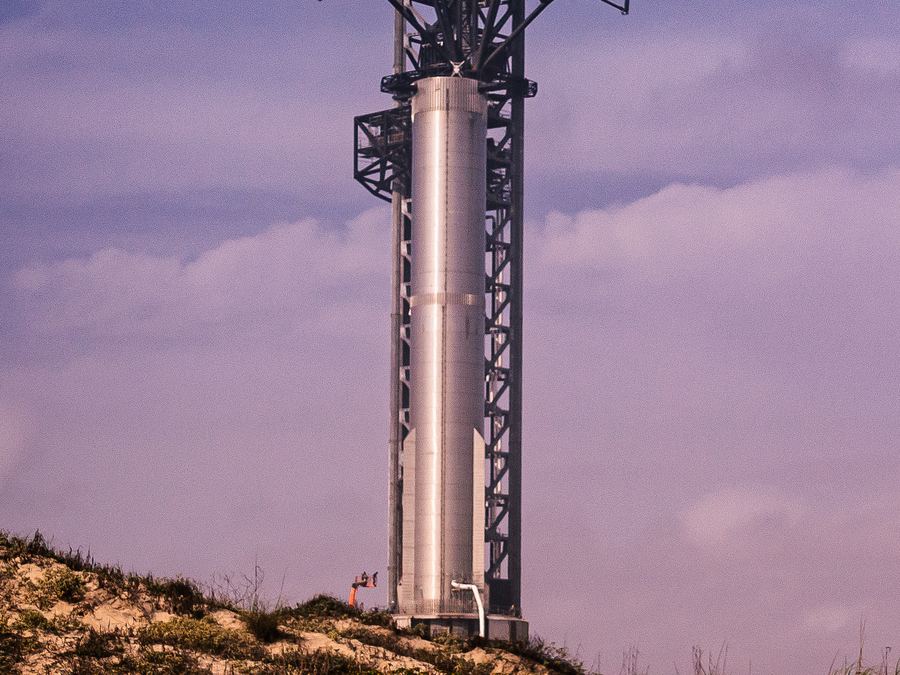
Flight 14 follows Flight 13 on 24 July 2026. Until now, Starship’s integrated tests have flown suborbital arcs — up, coast, down — without locking a closed orbit. An orbital attempt changes the physics the vehicle must prove. Roughly 7.8 km/s of horizontal velocity is required for sustained freefall around Earth; altitude alone does not write an orbit. India Today, reporting on 11 September, says Booster 21 and Ship 41 are third-generation V3 vehicles: Ship 41 ran a single-engine firing on 19 August sized like a deorbit burn, then a six-engine, 60-second static fire two days later; Booster 21 completed a full-duration 33-engine static fire at Starbase on 28 August. With those ground milestones done, the remaining public gate is regulatory timing — including an FAA launch license — plus weather and range.
Secondary reporting around the same window, including Tech Times on 11 September, describes the flight as the first Starship FCC paper to call out an “orbital second stage,” with an intended Starlink V3 deployment date in mid-September and a Special Temporary Authorization for V3 downlink in the 42.0–42.5 GHz band after release. India Today separately notes that Flight 13 already flew a V3 stack and briefly deployed Starlink V3 hardware on a suborbital path before re-entry; the desk therefore treats “first revenue orbit” claims as secondary until SpaceX publishes its own mission card. What is load-bearing from the open FAA planning page and India Today’s ground-test chronology is simpler: federal airspace is now being shaped around an 18 September Starbase attempt, and the company has finished the big static fires on the stages named for that flight.
No booster tower catch is expected on this profile in the secondary accounts; the booster is described as targeting a Gulf of Mexico splashdown after boostback, with Ship 41 aimed at an Indian Ocean corridor after any orbital coast and deorbit burn. SpaceX has not, as of the pages opened for this edition, posted a final countdown clock. NASA continues to count on a Starship-derived Human Landing System later in the Artemis stack — a dependency that starts with reliable orbital operations and in-space propellant transfer, neither of which this single flight finishes.
What comes next is mechanical and public: either SpaceX adopts the 18 September window and the FAA keeps the advisory, or the planning date moves. Readers should watch for a company target, a license notice, and more specific maritime and airspace restrictions — not for a guarantee stamped on an Operations Plan Advisory.
Floor: FAA airspace planning holds 18 Sep (19 backup) for Starship Flight 14 at Starbase; SpaceX confirmation and license still gate the clock.