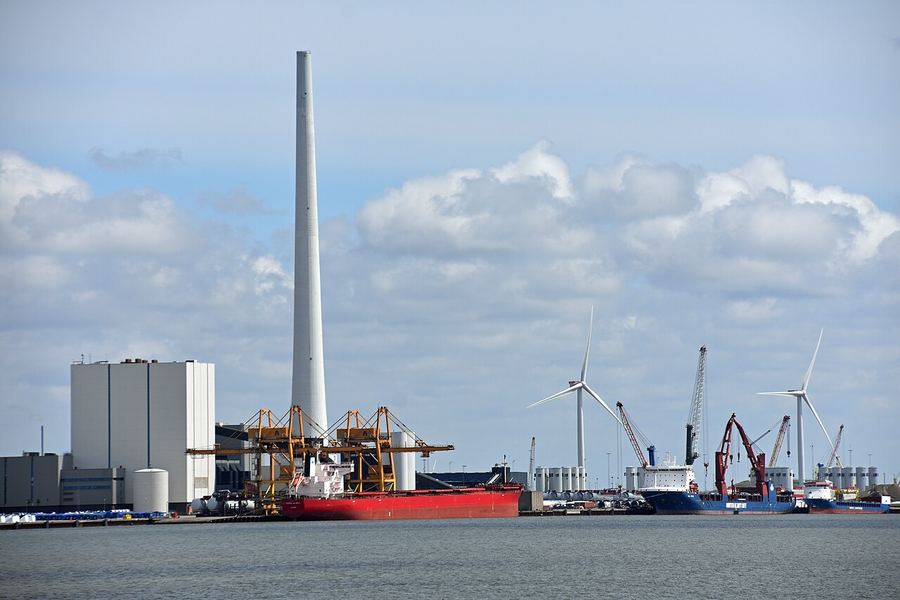
Greensand, the European Union’s first full-scale offshore carbon dioxide storage project, moved into commercial operation on Friday, 18 September 2026, according to INEOS’s project release, World Oil’s same-day report and a Reuters Copenhagen dispatch, all opened for this pack. His Majesty King Frederik X of Denmark formally opened the facility at a Port of Esbjerg ceremony. The project is led by INEOS Energy with partners Harbour Energy and the Danish North Sea Fund (Nordsøfonden). Soft FLAG: “EU’s first full-scale” is INEOS’s and Reuters’ framing; Reuters notes Norway’s Northern Lights began storing CO₂ in August 2025 but Norway is not an EU member — attribute that distinction to Reuters.
The mechanism is a complete capture-to-reservoir chain. INEOS and World Oil describe the first-phase path as follows: CO₂ is sourced primarily from Danish biomethane plants; it is liquefied; trucks deliver it to a dedicated CO₂ terminal at Port Esbjerg; it is shipped aboard Carbon Destroyer 1 — described by INEOS as the EU’s first purpose-built dedicated CO₂ carrier — roughly 250 kilometres offshore; and it is injected into the depleted Nini West oil field about 1,800 metres beneath the seabed for permanent geological storage. Soft FLAG: INEOS says the Nini reservoir’s integrity has been tested by the Geological Survey of Denmark and Greenland (GEUS) and that Greensand has received safety approval from independent verifier DNV — company attribution of third-party clearances, not desk verification of the certificates.
Named actors and capacity, as opened sources state them: Sir Jim Ratcliffe, Chairman of INEOS, said Europe will not achieve net zero by closing factories and exporting jobs and called Greensand “a fully operational carbon transport and storage business,” not a pilot. David Bucknall, CEO of INEOS Energy, said the project brings the EU’s first full-scale CO₂ storage site and value chain into operation. Mads Gade, CEO of INEOS Energy Europe, said Greensand starts with biogenic CO₂ and is ready to expand to receive CO₂ from industries across Europe. European Commissioner for Energy and Housing Dan Jørgensen, quoted in the INEOS release and Reuters, called the Esbjerg launch a move from demonstration to deployment. Soft FLAG: INEOS editorial notes that Europe’s energy-intensive industries employ almost eight million people and generate roughly €550 billion in value added, and that EU capture-and-storage targets are 50 million tonnes annually by 2030 and 250–280 million tonnes by 2040 — company policy colour, attributed.
First-phase storage capacity is up to 400,000 tonnes of CO₂ a year, INEOS, World Oil and Reuters agree. The site is designed to expand toward a potential of up to 4–8 million tonnes annually at full capacity, the same three sources report. Soft FLAG: the 4–8 million-tonne band is design potential, not a dated COD for the expanded phases. Soft FLAG: initial feedstock is primarily biogenic CO₂ from Danish biomethane plants while larger industrial capture projects continue to develop — INEOS’s sequencing claim.
What to watch without mood: first published injection and shipped-tonnage figures after the 18 September opening; any offtake or terminal announcements that move industrial (non-biogenic) volumes onto the Esbjerg–Nini path; regulatory or investment conditions EU institutions attach to scaling capture to match storage that is now live.
Floor: Greensand commercial 18 Sep — EU’s first full-scale offshore CO₂ storage (co./Reuters); up to 400,000 t/yr phase 1; truck→Esbjerg→Carbon Destroyer 1→Nini West ~1,800 m; path to 4–8 Mt/yr.