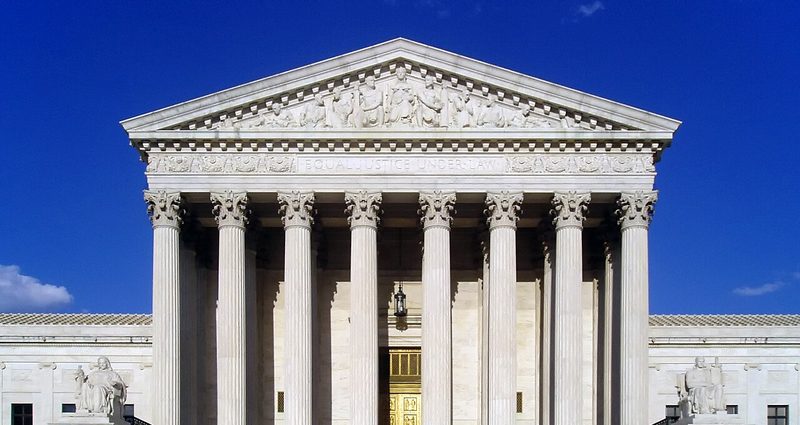
WASHINGTON — The Supreme Court on Friday, 25 September 2026, allowed the federal government to resume using an expanded system that checks whether registered voters are U.S. citizens by matching their records against Social Security files. A federal judge had shut the system down in June after voting-rights and privacy groups sued. The Supreme Court's order does not end the lawsuit. It puts the judge's ruling on hold, which means the system can operate while the case moves through the appeals courts. The midterm elections are on 3 November.
What the system is
The system is called SAVE, short for Systematic Alien Verification for Entitlements. It is run by the Department of Homeland Security, the federal agency responsible for immigration. Since 1986, government agencies have used SAVE to check a person's citizenship or immigration status before giving them public benefits.
In March 2025, President Trump signed an executive order (a written directive from the president to federal agencies) telling Homeland Security to help state and local election officials check whether the people on their voter rolls are citizens. The order also told the Social Security Administration, the agency that runs Social Security and keeps records on the people enrolled in it, to share its records with Homeland Security for that purpose.
Two months later, Homeland Security launched an expanded version of SAVE. According to the Supreme Court, it added two things. First, it checks voters against Social Security records, including Social Security numbers. Second, it lets officials check large numbers of people at once instead of one at a time.
This is how it works. A state election office uploads identifying details about its voters. The Social Security Administration sends back whether each person matches its records, including whether its records show the person as a citizen. If the system cannot confirm that someone is a citizen, the election office must ask that person for proof of citizenship before the person can register or stay registered.
Why it was challenged
The League of Women Voters, the Electronic Privacy Information Center and other groups sued. They argued that the expanded system broke three federal laws. The first is a part of the Social Security Act that keeps Social Security records confidential. The second is the Privacy Act of 1974, which limits how federal agencies can share personal information about people. The third is the Administrative Procedure Act, which sets the rules federal agencies must follow when they create or change programs and lets courts strike down agency decisions that are arbitrary or break the law.
One of the groups' members is a naturalized citizen registered to vote in Louisiana. A naturalized citizen is someone who was not a U.S. citizen at birth and became one through the legal process called naturalization. Court papers identify her only as "J. Doe 4." Louisiana used the expanded system. Her Social Security records do not show that she became a citizen, so the system would likely have flagged her and required her to show extra proof of citizenship. The groups argue that many recently naturalized citizens face the same problem, because Social Security records are not always updated when a person becomes a citizen.
On 22 June 2026, a federal district court in Washington, D.C. (the trial-level court where the case began) agreed with the groups and struck down the expanded system. The government asked that court to pause its ruling during the appeal, and the court refused. The government then asked the U.S. Court of Appeals for the D.C. Circuit, the next court up. A three-judge panel of that court also refused, with one judge, Gregory Katsas, disagreeing. The government then went to the Supreme Court.
What the Supreme Court decided
The Supreme Court granted a "stay." In law, a stay is a pause. It stops a lower court's ruling from taking effect for a period of time. The justices did not issue a final decision on whether the expanded system is legal. However, to grant a stay, the Court must find that the government has a fair chance of winning in the end and would be seriously harmed without the pause. The Court said the government likely would win and that the balance of harms favored it.
The Court issued the decision as an unsigned opinion, meaning no single justice is named as the author. It speaks for the Court's six-justice majority. The Court agreed that the groups likely have the legal right to sue, called "standing," because one of their members, J. Doe 4, could personally be harmed. But it said the groups' legal arguments are likely to fail.
The Court's reasoning rests on a federal immigration law, Section 1373 of Title 8 of the U.S. Code, the official collection of federal laws. According to the Court, that law allows Homeland Security to request and receive citizenship and immigration information from other federal agencies, including the Social Security Administration, even if other laws would otherwise restrict that sharing. The same law also requires Homeland Security to answer state and local officials who ask it to verify someone's citizenship or immigration status.
"The federal Government has an obligation to respond to requests from state and local election officials seeking to verify the citizenship of voters. The order below [the lower court's ruling] prevents the federal Government from using the program it believes is best suited to the task," the Court wrote.
The dissent
Three justices disagreed: Ketanji Brown Jackson, Sonia Sotomayor and Elena Kagan. Writing for the three, Justice Jackson said the other six justices misread the immigration law. She also said they ignored the harm to recently naturalized citizens, whose Social Security records, she said, can wrongly show them as non-citizens. And she said the Court misused its power to pause lower-court rulings.
Reactions
The League of Women Voters called the decision "profoundly disappointing," the Los Angeles Times reported. The group said it puts millions of Americans at risk of being "unlawfully targeted" by an "unreliable voter purge database" weeks before the midterms. Virginia Kase Solomón, president of the voting-rights group Common Cause, said that removing large numbers of voters within 90 days of an election is "flatly illegal." She said the group would sue if officials use the database to try to block eligible voters.
Texas supported the federal government in the case. It told the Supreme Court that it ran its entire list of 18 million registered voters through the expanded system "in bulk and for no cost," and that 2,724 people were flagged as "potential non-citizens." Those names were sent to county officials for further review, the Times reported. Being flagged does not mean a person is a non-citizen. It means the records did not confirm citizenship and the county has to look further.
The 90-day rule
A 1993 federal law, the National Voter Registration Act, limits how states can remove voters from the rolls close to an election. In the 90 days before a federal election, states must stop running programs that systematically remove ineligible voters from the rolls, such as checking a whole list against a database. Individual, case-by-case checks are still allowed, the Supreme Court said. For the 3 November midterms, that window opened in early August, so it is already in effect.
The Supreme Court acknowledged that this rule limits how much its order can change before the midterms. But it said the lower court's ruling had also blocked individual, one-person-at-a-time checks, which federal law does allow during the 90-day window. Those individual checks can now resume.
Exactly what the 90-day rule covers is still an open question. The Supreme Court said it will decide that in a separate case, Republican National Committee v. Mi Familia Vota, brought by the Republican Party's national committee over an Arizona voter law. That case asks whether the rule stops states from running programs to cancel the registrations of non-citizens within 90 days of a federal election.
What happens next
The government's full appeal is already pending in the D.C. Circuit appeals court, which will decide it. Whichever side loses there can ask the Supreme Court to take up the case. The pause stays in place until that process ends. If the Supreme Court declines to hear the case, the pause ends automatically. If it agrees to hear it, the pause lasts until the Court issues its final judgment. Until then, states that want to use the expanded system can do so, within the limits of the 90-day rule.
Floor: Supreme Court, 25 Sep 2026, Department of Homeland Security v. League of Women Voters (application No. 26A308). The unsigned opinion pauses the 22 June 2026 district court ruling that struck down the expanded SAVE system until the appeal and any further Supreme Court review are finished. Justices Jackson, Sotomayor and Kagan dissented. The Court noted the 90-day federal limit on systematic voter-roll removals before a federal election; its scope will be decided in Republican National Committee v. Mi Familia Vota (No. 25-1017). Texas checked 18 million voters and flagged 2,724 as potential non-citizens (Los Angeles Times). Sources: Supreme Court opinion and Los Angeles Times, 25 Sep.