
Money · Washington
Parents Must Claim Children's Trump Accounts
The White House says nearly 70 million children now have a government-opened investment account, but the $1,000 deposit for children born 2025–2028 arrives only after a parent claims it.
By ClarkWashington · Thursday, 8 October 2026
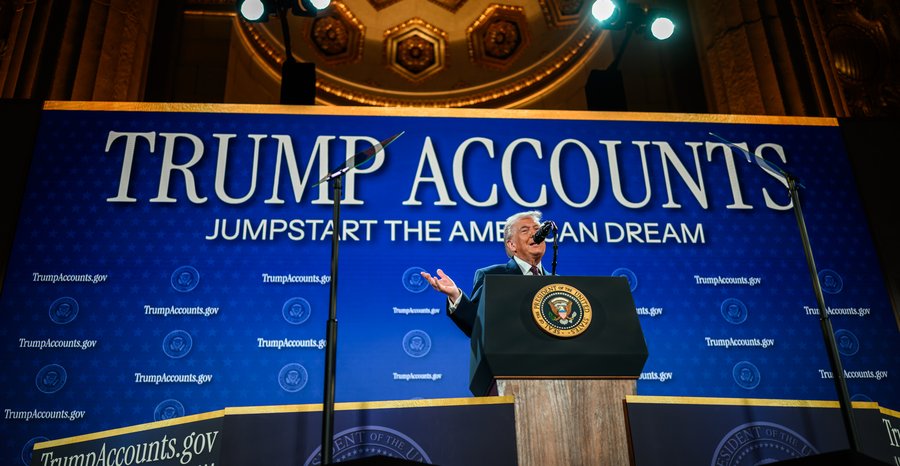
Washington — The U.S. government has now opened an investment account in the name of nearly every child in the country, President Trump announced at the White House on 7 October. The money will not reach most of them, though, until a parent or guardian claims the account.
The White House said nearly 70 million of these accounts, called Trump Accounts, now exist, more than 60 million of them opened automatically by the government. Every American child under 18 who has a Social Security number now has one, it said.
What a Trump Account is
A Trump Account is a savings account in a child's name that is invested in the stock market and gets special tax treatment; the White House calls it "tax-advantaged," and Trump called it "a tax-free investment account." The accounts were created by the large tax law Trump signed in the summer of 2025, which the White House calls the Working Families Tax Cuts legislation and which the president has called the "Big, Beautiful Bill."
The money is handed to private firms that invest it in index funds, a kind of fund that simply follows the whole stock market rather than picking shares, according to a report by WTAE, a television station in Pittsburgh. Money generally cannot be taken out before the year the child turns 18. After that, the account follows the rules for a traditional individual retirement account: withdrawals are taxed, and before age 59½ they can face a 10 percent penalty unless an exception, such as college costs or a first home, applies, according to Treasury and Internal Revenue Service guidance.
Who gets $1,000
Children who are U.S. citizens and were born between 1 January 2025 and 31 December 2028 and have a Social Security number get a one-time $1,000 deposit from the Treasury, according to the Internal Revenue Service. Children born before 2025 do not qualify for the deposit.
That $1,000 is not paid automatically. "Eligible children must also have their Trump Account claimed to receive the one-time $1,000 seed contribution from Treasury," the Treasury said in its 1 October announcement. To claim, a parent or guardian uses the Trump Accounts app to prove who they are and how they are related to the child, check the child's details and accept the account's terms.
Who else can pay in
Family and friends can put in up to $5,000 a year in total, the White House said. An employer can give up to $2,500 a year toward a worker's child, inside that same $5,000 limit. More than 70 companies have promised to contribute for their employees, the White House said. Some children also qualify for gifts from philanthropists, which are deposited automatically.
How much is in them
Since the accounts opened on 4 July, more than $4.5 billion has gone in, according to the White House. That includes $1.3 billion in $1,000 government deposits, more than $600 million from family and friends, and $2.6 billion in gifts from philanthropists.
That money is spread across far fewer children than the 70 million total. Frank Bisignano, who runs both the Internal Revenue Service and the Social Security Administration, said about 10 million of the accounts now hold money, WTAE reported.
The White House said an estimated 80 percent of the accounts belong to families earning less than $200,000 a year.
Who was there
Trump spoke alongside Treasury Secretary Scott Bessent, Bisignano, the philanthropists Michael and Susan Dell and the investor Brad Gerstner, whose gifts have paid into millions of the accounts.
"Today I'm pleased to announce that every single eligible minor child in America has now been automatically enrolled in a Trump account," Trump said.
"Knowing that someone believes in you and your future, that matters just as much" as the money, Susan Dell said, according to WTAE.
What the money could grow into
The White House said a balance could grow from a couple of thousand dollars in kindergarten to about half a million dollars by retirement. That is a long-range projection, not a promise.
WTAE's data team ran a simpler sum. The S&P 500, a measure of large American companies' shares, has returned more than 10 percent a year on average since 1957, the station noted. At that rate, a $1,000 deposit left alone for 18 years would grow to about $5,600. After taxes and an early-withdrawal penalty, experts told the station, a child might keep closer to $3,600. Stock markets also fall, and returns are not guaranteed.
The politics
The accounts passed as part of a tax law that no Democrat voted for, a point the White House repeated in its announcement. Trump complained of a lack of support from Democrats, WTAE reported.
What parents need to do
The account already exists. A parent who wants the $1,000 deposit for an eligible child, or who wants relatives to be able to add money, has to claim it in the Trump Accounts app.
Floor: Nearly 70 million accounts are open, the White House says. How many children actually get the money now depends on how many parents claim them.
Sources: https://www.whitehouse.gov/releases/2026/10/a-financial-stake-in-the-future-for-nearly-70-million-american-children-trump-accounts-made-it-possible/; https://www.wtae.com/article/president-trump-announcement-oct-7-oval-office/74066379; https://home.treasury.gov/news/press-releases/sb0642; https://www.irs.gov/newsroom/treasury-irs-issue-proposed-regulations-for-trump-accounts-contribution-pilot-program-treasury-department-to-deposit-1000-into-the-account-of-each-eligible-child; https://www.federalregister.gov/documents/2026/03/09/2026-04533/trump-accounts.