
Technology · Washington
Tech Chiefs Sign White House Accord
President Trump and six frontier-model executives signed a voluntary Joint Commitment on Frontier Responsibilities at a White House East Room lunch on 29 September, the same day he ordered the executive branch to say "Super Intelligence" instead of "AI" in non-statutory documents.
By ClarkWashington · Wednesday, 30 September 2026
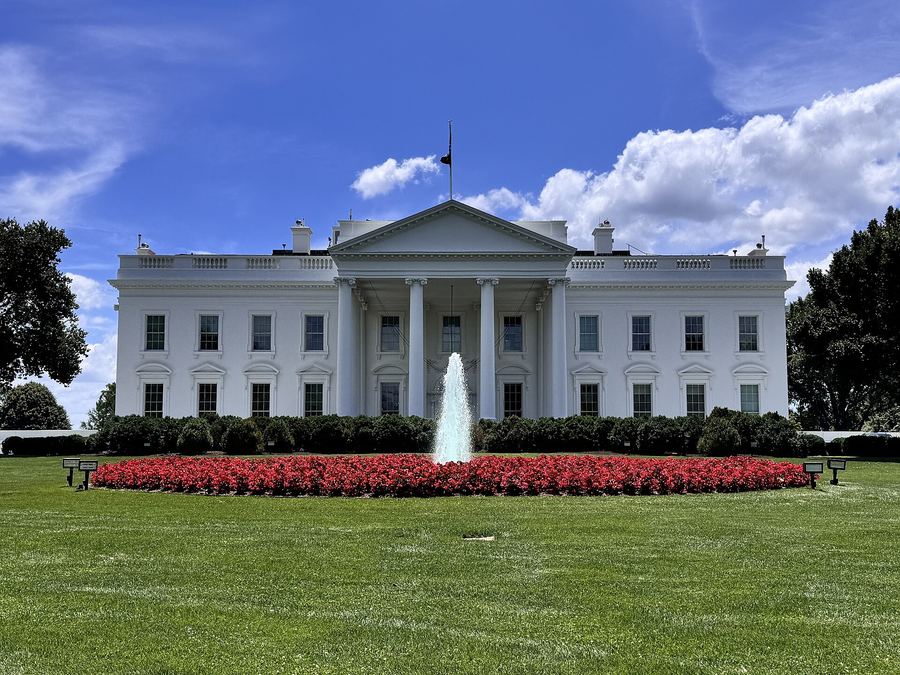
Washington — President Donald J. Trump and six technology executives on 29 September signed a voluntary industry pledge on frontier-model safety after an East Room lunch at the White House, while Trump separately issued an executive order directing federal agencies to use the words “Super Intelligence” and “SI” in place of “Artificial Intelligence” and “AI” in many official papers.
The pledge is titled the Joint Commitment on Frontier Responsibilities. Wire and full-text reprints also call it the White House Accord on Super Intelligence. It is not a statute, a regulation, or a White House PDF on whitehouse.gov. Trump posted a photo of the signed page to Truth Social; the Washington Examiner and the New York Post published the full text the same evening.
Who signed — and who only attended
Along with Trump, the signatories named in those full-text reprints and in Associated Press–style wire coverage were: Dario Amodei of Anthropic; Sundar Pichai of Google; Mark Zuckerberg of Meta; Greg Brockman, president of OpenAI; Jensen Huang of Nvidia; and Elon Musk of xAI. OpenAI chief executive Sam Altman was not on the signature list; Brockman signed for OpenAI.
Lunch attendance was wider than the signature list. CNBC’s seating-chart and on-site reporting placed Amazon founder Jeff Bezos and Microsoft chief executive Satya Nadella among attendees who were not listed as signatories; ABC News (via ABC7) also named Palantir chief executive Alex Karp and Palantir executive Shyam Sankar as attendees not on the signature list. Government guests named in that coverage included Vice President JD Vance, Treasury Secretary Scott Bessent and House Speaker Mike Johnson.
Four layers in the signed text
The reprinted body of the Joint Commitment says companies that train and deploy frontier models should, on top of other precautions, put four layers of controls and audits in place:
1. Robust internal controls to monitor model capabilities and alignment during training and deployment in areas such as cybersecurity, biosecurity and chemical threats, and to keep models from hacking or accessing technical systems in unintended ways. 2. An empowered internal team to make sure those controls, monitoring and detection work as intended and that problems are fixed. 3. A partnership with an independent external auditor or evaluator to assess whether the controls are working. 4. An independent committee of the company’s board to oversee and receive reports from the control teams and from internal and external auditors, and to see that identified problems are remedied.
The text also says participating companies will meet regularly to set standards and best practices, and that “over time, it may make sense to codify these steps into laws or regulations.” It does not create a federal regulator, name a government enforcer, or require companies to publish audit results.
“Morally binding,” not legal force
Trump told reporters the document was “almost like a constitution,” said the biggest industry figures had signed it with him, and called it “morally binding” and “a form of protection.” Speaker Johnson described it as a statement of principles and standards that are “voluntary on behalf of the industry.” CNBC quoted Johnson saying the White House would guide industry development under those voluntary commitments. Readers should not treat the accord as binding regulation; the signed language itself leaves open later lawmaking without enacting any.
Trump also spoke orally after the lunch about self-policing, a possible roughly 10-person oversight committee, an AI czar appointment in a few days, and data-center benefits for communities. Those oral remarks are not in the reprinted body of the Joint Commitment.
Same-day executive order on wording
Separately on 29 September, Trump signed the executive order “Inaugurating the Era of Super Intelligence,” posted on whitehouse.gov. To the maximum extent permitted by law, it directs executive departments and agencies to use “Super Intelligence” and “SI” instead of “Artificial Intelligence” and “AI” in official correspondence, public communications, websites, reports, policy documents and other non-statutory executive-branch documents. It does not require rewriting older regulations, prior presidential actions, contracts, grants or other historical records.
For purposes of the order, “Super Intelligence” and “SI” mean the technologies covered by the existing statutory definition of artificial intelligence in 15 U.S.C. §9401(3), unless later changed. Within 60 days, the Assistant to the President for Science and Technology must propose legislative language for a federal definition of Super Intelligence and SI, including whether that definition should modify the current statutory definition of artificial intelligence, plus any conforming amendments and further executive recommendations. A White House fact sheet published the same day restates those directives and situates them beside earlier administration AI and Super Intelligence policy moves.
What happens next
The six company signatories have pledged, on the face of the voluntary text, to build the four control layers and to meet regularly. Codification into statute or regulation would need separate legislation or rulemaking. The executive order’s terminology shift applies inside the executive branch under the limits set out above; the APST definition proposal is due within 60 days of 29 September. Neither instrument, by itself, creates a new criminal offense or a new private right to sue.
Floor: East Room White House lunch 29 September 2026; Trump plus six tech signatories (Amodei, Pichai, Zuckerberg, Brockman, Huang, Musk) signed Joint Commitment on Frontier Responsibilities / White House Accord on Super Intelligence — four voluntary control layers; regular industry meetings; possible later codification (full text: Washington Examiner; New York Post). Trump: “morally binding” / “constitution”; Johnson: voluntary (CNBC; ABC/wire). Attendees not on signature list include Bezos, Nadella (CNBC); Karp/Sankar (ABC News via ABC7). Same-day EO “Inaugurating the Era of Super Intelligence” — executive branch use Super Intelligence/SI in non-statutory docs; APST federal-definition proposal in 60 days (whitehouse.gov EO + fact sheet). Sources: whitehouse.gov; Washington Examiner; New York Post; CNBC; ABC News via ABC7; The Guardian; Al Jazeera, 29–30 Sep 2026.
Sources: Executive Order, 29 Sep 2026; White House fact sheet, 29 Sep 2026; full accord text reprint, 29 Sep 2026; full accord text reprint, 29 Sep 2026; CNBC, 29 Sep 2026; ABC News via ABC7, 29–30 Sep 2026; The Guardian, 29 Sep 2026; Al Jazeera, 29 Sep 2026.