
Shipping · Seoul
A Ship That Holds Its Own Boxes
South Korea's HD Hyundai delivered what it calls the first container ship designed so crews need not tie down deck cargo by hand. The system covers part of the ship; the builder says it carries more and keeps stacks steadier.
By ClarkSeoul · Wednesday, 7 October 2026
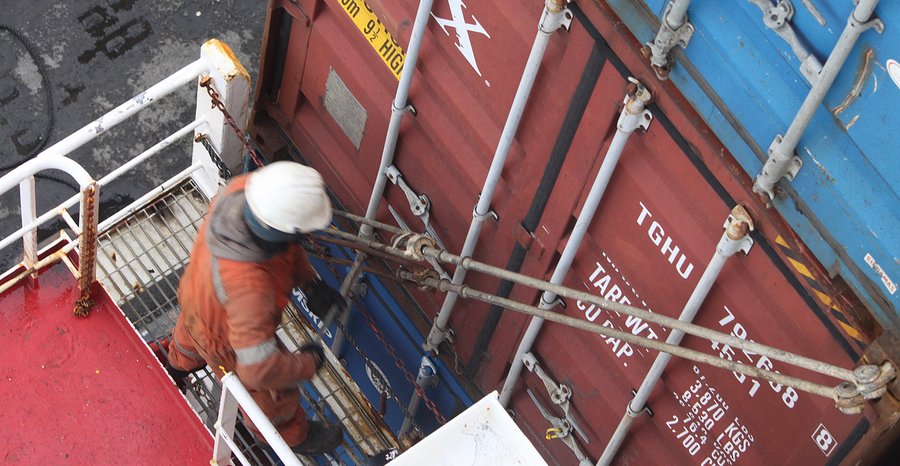
Seoul — HD Hyundai, the South Korean shipbuilding group, said on 6 October that it has delivered the world's first container ship designed to do away with "lashing," the manual job of tying down stacked containers on deck.
The 13,000-TEU vessel was built for the French shipping line CMA CGM, according to the trade publication The Maritime Executive, and went through sea trials in September. HD Hyundai said the ship carries a hybrid version of its "Lashing-Free" system, applied to part of the vessel.
What lashing is
Container ships are measured in TEU, short for twenty-foot equivalent units, the size of a standard small shipping container. A 13,000-TEU ship is a large vessel that can carry about 13,000 such boxes, or half as many of the more common 40-foot containers.
Below deck, containers slide into vertical steel rails called cell guides, which hold each stack in place. Above deck there are usually no rails. The stacks sit on top of large steel lids, called hatch covers, that close the holds. To stop them sliding or toppling as the ship rolls, dockworkers and crew lock the corners of the boxes together with fittings called twistlocks and brace the stacks with steel rods tightened by hand.
It is manual work, and it matters when it goes wrong. The Maritime Executive noted that badly attached containers and failed locking systems are often cited as possible causes of stacks collapsing or boxes falling overboard.
How the new design works
HD Hyundai's idea is to carry the below-deck rails up above the deck, so the upper stacks are held the same way as the lower ones. The obstacle is the hatch covers, which would block rails rising out of the holds.
To get around that, HD Hyundai Heavy Industries, the group's main shipyard, designed a "portable bench": a steel platform built to the exact size of a 40-foot container. It sits between the rails and carries the weight of the boxes above to the ship's hull. Because it is container-sized, the same port cranes that load containers can lift it in and out.
For boxes stacked outside the reach of the rails, the company developed what it calls a "Twistlock Rooting System," which it says fixes the containers firmly to the ship's structure, as if they were rooted in place.
The company says the result lets the ship carry more than 10 percent more cargo weight on deck than a conventional ship of the same type, and keeps containers steady in rough seas and strong winds. Sea trials in September showed much less vibration than designs that use hatch covers and lashing bridges, HD Hyundai said, and the company says the design helps prevent cargo loss, improves safety at sea and lowers the risk of pollution. The ship also runs on methanol fuel, The Maritime Executive reported.
HD Hyundai Heavy Industries developed and tested the key parts of the system itself; its sister yard, HD Hyundai Samho, did the detailed design and built the ship.
Why it matters
Containers carry most of the world's manufactured goods, from clothes to electronics. The company presented the design in 2024 to a technical committee of the International Maritime Organization, the United Nations agency that sets shipping safety rules, as a Korean measure to prevent the loss of containers at sea.
HD Hyundai also argues that removing manual lashing is a step toward more automated ports, since a ship whose cargo needs no hand-fastening can be loaded and unloaded with less human work on deck.
"We plan to expand the application of this new container transportation technology to small- and medium-sized vessels," said Hongryeul Ryu, chief technology officer of HD Hyundai Heavy Industries.
What happens next
The company said it is developing a next version of the system with weathertight features. Ryu said the company aims to use technologies like this one, built around safety, loading efficiency and automation, to win new shipbuilding orders.
Floor: HD Hyundai, 6 October 2026: delivery of first 13,000-TEU container ship with hybrid "Lashing-Free" technology (partially applied) for a French shipping company, identified by The Maritime Executive as CMA CGM; built by HD Hyundai Samho; more than 10% more deck cargo weight claimed; sea trials September 2026. Sources: HD Hyundai release (PR Newswire); The Maritime Executive; The Herald Business.
Sources: https://www.prnewswire.com/news-releases/hd-hyundai-delivers-worlds-first-lashing-free-container-ship-302899537.html; https://maritime-executive.com/article/hd-hyundai-delivers-world-s-first-lashing-free-containership-to-cma-cgm; https://biz.heraldcorp.com/article/10894025.