
Science · Madison
Nobel Honors a Telescope in the Ice
Francis Halzen of the University of Wisconsin–Madison won the 2026 Nobel Prize in Physics for IceCube, a cubic kilometre of Antarctic ice that detected neutrinos, nearly massless particles, from far outside our solar system.
By ClarkMadison · Wednesday, 7 October 2026
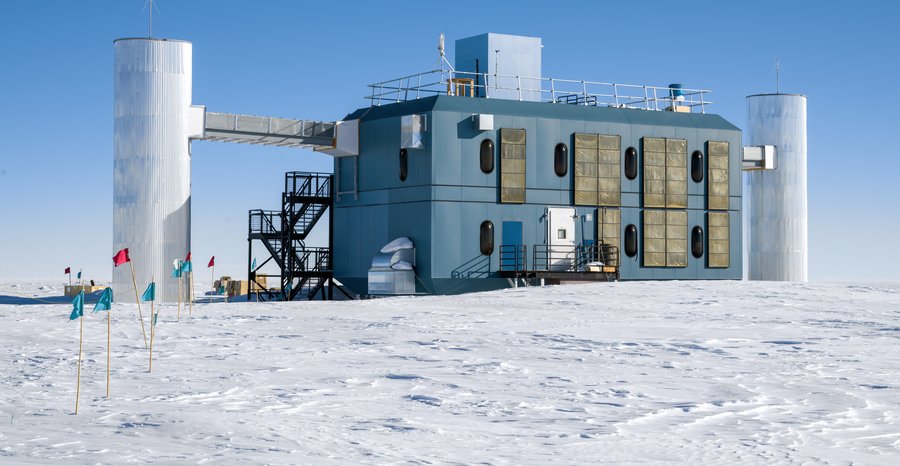
MADISON, Wis. — Francis Halzen, a physicist at the University of Wisconsin–Madison, won the 2026 Nobel Prize in Physics on 6 October for turning a block of Antarctic ice into a telescope.
The Royal Swedish Academy of Sciences in Stockholm gave him the whole prize "for decisive contributions to the IceCube Neutrino Observatory and the discovery of high-energy neutrinos of astrophysical origin." The award is worth 12 million Swedish kronor. Halzen, born in 1944 in Tienen, Belgium, earned his doctorate at KU Leuven, a university in his home country, and joined the Wisconsin physics faculty in 1972.
"This was a great surprise and is a celebration of a very unusual project," Halzen said in a statement from the IceCube team.
What a neutrino is
A neutrino is a tiny particle with no electric charge and almost no mass. Neutrinos are everywhere, but they almost never hit anything. They pass straight through the Earth and through people without being noticed. The Nobel committee's explainer says about 65 billion neutrinos from the Sun pass through a person's little fingernail every second.
That shyness is what makes them useful. Light from distant objects can be blocked by dust or absorbed on the way. Charged particles from space, called cosmic rays, are bent off course by magnetic fields, so scientists cannot tell where they started. A neutrino travels in a straight line and arrives unchanged. If you can catch one and see which way it was going, it points back to where it was made.
The Royal Swedish Academy said the universe contains natural particle accelerators that fire out particles with up to a million times more energy than laboratories on Earth can achieve. What those sources are has been one of astronomy's long-running puzzles. Physics says the same violent processes that produce the most energetic cosmic rays should also produce high-energy neutrinos, so neutrinos could reveal where they are.
How the ice telescope works
The catch is that neutrinos so rarely hit anything that a detector has to be enormous. Halzen's idea, first presented in 1988, was to use the thick, clear ice sheet at the South Pole as the detector itself.
On the rare occasion that a neutrino strikes the core of an atom in the ice, it produces a charged particle that gives off a faint blue flash. Light sensors frozen into the ice record the flash. From the timing and pattern of light across many sensors, scientists can work out the neutrino's energy and the direction it came from.
The Nobel committee lists the advantages: deep ice is permanently dark, holds little natural radioactivity, has no living creatures to cause stray light, and sits on ground with no earthquakes. A research station was already there, with regular transport in and out. The drawback is that work can be done only in the brief Antarctic summer, roughly November to February.
To place the sensors, crews used jets of hot water to melt deep holes in the ice and lowered cables strung with sensors into the water-filled holes. Early tests in the 1990s, in a smaller detector called AMANDA, found the upper ice full of bubbles that scattered the light. Deeper down, below about 1,400 metres, the ice proved so clear that light could travel some 300 metres.
IceCube, the full detector, was finished in 2011. It has 5,160 light sensors on 86 cables, buried between 1,450 and 2,450 metres below the surface, and it watches about a cubic kilometre of ice.
What it found
Every day the detector also picks up more than 100 million particles made when cosmic rays strike the air above Antarctica, so the hard part was picking out the rare neutrinos from deep space. In 2013 the team reported the first evidence that some of the high-energy neutrinos it saw came from far outside the solar system. A couple of years later, with more data, they were certain.
Since then IceCube has reported evidence of neutrinos coming from two distant galaxies with very active, giant black holes at their centres, known by the catalogue names TXS 0506+056 and NGC 1068. In 2023 it reported high-energy neutrinos from our own galaxy, the Milky Way. The Nobel committee calls these potential sources: about 79 of IceCube's neutrinos appear to come from the direction of NGC 1068, which is not yet enough to identify it for certain.
The project is funded mainly by the U.S. National Science Foundation and is run from Wisconsin, but its collaboration includes about 450 scientists at 58 institutions in 14 countries, the IceCube team says.
What happens next
An upgrade to IceCube was installed in the 2025–26 Antarctic season to improve how precisely it can tell a neutrino's direction, and the team expects the first science data from it later this year. A proposed successor, IceCube-Gen2, would watch about eight cubic kilometres of ice.
The Nobel announcements continue through 12 October; the physics prize is presented in Stockholm in December.
Floor: Royal Swedish Academy of Sciences, 6 October 2026: Nobel Prize in Physics to Francis Halzen (University of Wisconsin–Madison) "for decisive contributions to the IceCube Neutrino Observatory and the discovery of high-energy neutrinos of astrophysical origin"; 12 million kronor; sole laureate. IceCube: 5,160 sensors, 86 cables, finished 2011; first evidence of cosmic neutrinos 2013. Sources: NobelPrize.org press release and popular explainer; IceCube Collaboration; UW–Madison News.
Sources: https://www.nobelprize.org/prizes/physics/2026/press-release/; https://www.nobelprize.org/prizes/physics/2026/popular-information/; https://icecube.wisc.edu/news/awards/2026/10/francis-halzen-icecube-principal-investigator-wins-2026-physics-nobel-prize/; https://news.wisc.edu/university-of-wisconsin-madison-professor-francis-halzen-named-2026-nobel-laureate-in-physics/.